
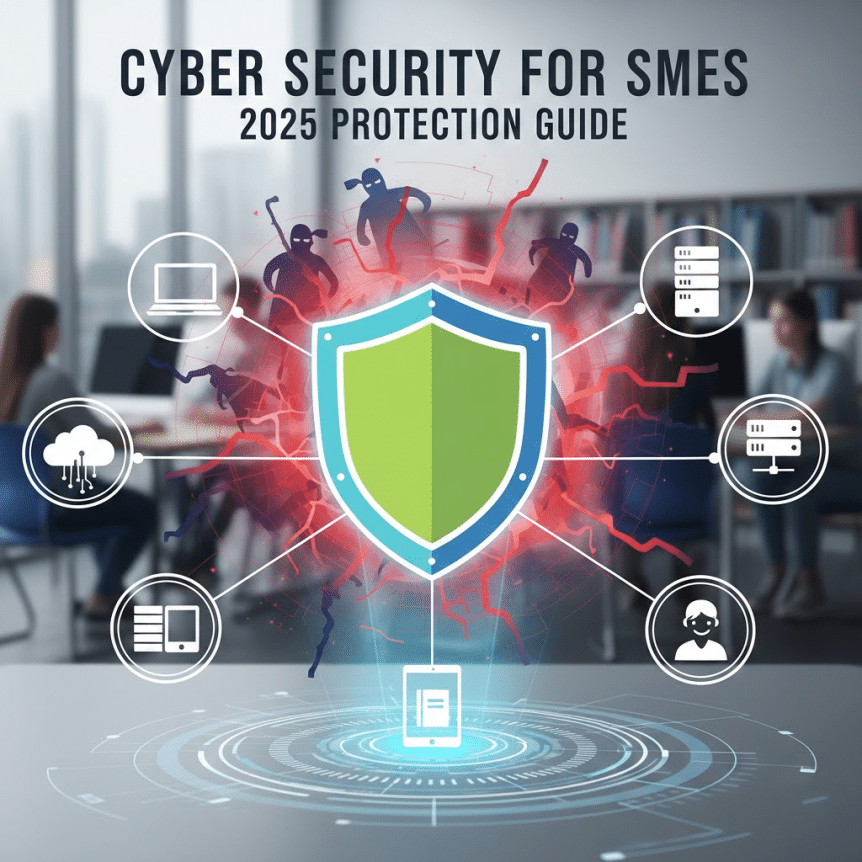
The large company usually makes headlines about the victims of cyber attacks. In reality, small and medium-sized enterprises have become prime targets for cybercriminals who see them as easier targets than large corporations. The myth that only large companies are attacked by hackers has left many organisations vulnerable to devastating attacks. In 2025, digital threats are increasing at an alarming rate, with attackers using advanced techniques to breach security. For small businesses, one breach can cost a large amount of money, reputation, and sometimes even closure. This is why cyber security for SMEs has become essential for survival in the market.
Here is a guide that discusses how SMEs can prevent cyber attacks:
Why cyber criminals are targeting small businesses now
Attackers have now started targeting small enterprises for several reasons. Ransomware teams encrypt company files and demand large amounts of money, while phishing emails deceive employees into handing over credentials. The supply chains have also become weak points, with hackers infiltrating smaller suppliers for backdoor access. These are the scenarios of SME cyber threats 2025 that are happening on a daily basis in industries.
Cybercriminals target smaller organisations since they do not have technical security personnel and strong defences. Your business likely stores valuable customer data, financial records, and intellectual property, all of which are attractive targets.
In most cases, businesses never recover fully from damage, which is why cyber security for SMEs is the most important.
Essential security measures every SME needs today
Getting basic security right makes a tremendous difference in protecting your business from common attacks. A properly configured firewall is like the first line of defence on your network, which inspects the traffic to identify any suspicious activity. Regular software updates patch vulnerabilities before hackers exploit them. Then, multi-factor authentication adds crucial extra layers in addition to passwords, requiring additional verification before access.
Take these basic steps that strengthen small business cybersecurity:
- Installing and maintaining updated antivirus and anti-malware programs
- Securing Wi-Fi networks with strong encryption
- Creating regular automated backups stored locally and in secure cloud storage
These basics are some of the cyber attack prevention for SMEs, stopping opportunistic attacks.
Safeguarding your important business data
Your company’s data represents valuable assets, yet many businesses don’t recognise this until it’s too late. There are customer records, financial documents, and proprietary information that require proper protection measures. Working remotely has also multiplied devices accessing company resources, and hence, endpoint security for SMEs is crucial in managing distributed workforces.
Every laptop, smartphone, and tablet is a vulnerable point for attackers. So, encrypting sensitive data means that even stolen devices cannot be read without decryption keys. Additionally, getting strong data protection for small businesses gives access controls so that employees can see only the required information.
Hence, the ransomware protection for small business requires a separate backup system that attackers cannot reach, even after infiltrating your main network.
Training your team to recognise and report threats
Your employees interact with potential threats every single day, often without realising the risk they are welcoming.
The phishing emails written by attackers today replicate trusted suppliers, banks, and internal communications with alarming accuracy. The attackers exploit human psychology by creating urgent messages that compel them to make quick decisions without verifying them. Therefore, staff cyber awareness training is important for effective phishing protection for SMEs.
The essential training components include:
- Recognising urgent requests for sensitive data or suspicious payment transactions bypassing procedures
- Checking suspicious emails with other channels of communication first
- Understanding actual risks behind unknown links or unexpected file attachments
Creating environments where employees comfortably report suspicious activity turns workforces into active security layers.
Building a complete protection strategy within your budget
Protecting your business doesn’t require unlimited resources. Developing a cyber security checklist for small businesses helps systematically address vulnerabilities. Secondly, create strong passwords and access control policies that form a strong access management backbone, which require unique passwords handled by business password managers. Additionally, regular security assessments help to identify weaknesses before attackers find them.
Follow cyber security trends for 2025, where all access requests are verified.
- Reviewing employee access routinely, removing permissions for former staff members
- Network segmentation, separating critical systems from general operations
- Designing incident response plans that will detail the exact steps after detecting breaches
These cyber security solutions for SMEs provide strong protection within budget limits.
Secure your business with professional support
Handling modern cyber threats is a resource burden and creates risky gaps that attackers take advantage of. To ease this, it is important to partner with experienced professionals who are knowledgeable of cyber issues impacting smaller organisations that make a difference in creating comprehensive security strategies. From initial risk assessments through ongoing monitoring and fast incident response, expert guidance keeps everything updated.
Do not wait until breaches expose vulnerabilities, and make some proactive moves now. Cygnet IT specialises in providing bespoke business network security solutions at an affordable rate, and hence assures the security in the current risky digital environment. Contact today, and get a free quote.